Businesses, on any size, has made it a point to use business management software to help them oversee all the operations that are needed to be done for their business. However, there might be a misconception that it is a one size fits all tool. It is not. It is normally a set of programs that work together to help a business thrive without having to go through the hassle of doing certain things manually.
In essence, it might also help relieve some of the pressure that these things put on either the owner or its their staff.
Which brings us to the question, what does tools such as those by Holded, the business management software, incorporate into their product’s design?
It is important to point out this early that this may not be applicable to all companies. However, this is basically the general theme across companies considering they normally allow their clients to customize as they see fit.
Accounting and Book keeping Systems
You will hear from the horse’s mouth – bookkeeping with physical books are slowly dying. No business does it the old way. There is no business in the world nowadays that does not use a software to monitor all their finances. This is because it is easier, more convenient, and less things to keep track of.
The paper system worked for a while, but that is also how you lose records. Papers can be torn and thrown away.
Also, the clutter it creates is not worth it.
Customer Relationship Management
Customer-wise, these systems help keep track of every single one. Their names, their addresses if they gave it, and their contact details, are all kept in a system that stays in one place without the danger of being lost among piles of others.
In addition, this is the part of the system that helps keep track of the inventory. By doing so, you will not run the risk of depleting your stocks until there is none left. If this happens, that is to the detriment of the business, and more so to the customer.
Task Management
This one helps keep track on what the staff involved in a project is doing, and where they are currently on the tasks that they were assigned with. You would think that it could be simple done in person. However, it is not. Under the pressure of it all, you might make mistakes, and although communication is always a highlight, it becomes difficult when you have loads of things going on. Having this simple tool in a software helps make it easier for everyone, making employees more productive.
Invoicing
As the name suggests, this basically help you monitor the money that comes in and is being used for the operation of the business. It also helps you generate an invoice for customers, especially when you are running a business which is mostly online.
Mobile Solutions
This basically allows staff members to have all the operation available on the go, which is very convenient.
Business management software is not a single entity in itself. It is a collection of efforts from several tools that aims to help a business grow and run smoothly. Something that human resources could from.
If you’re a decision-maker for a small business, you’ll already be well-aware that IT costs a lot – but, often, it feels like these are a series of costs that you simply cannot work around.
IT is one of those areas that provides a double impact to your budget. For every pound or dollar that goes on a capital expenditure report, there’s another five that are backing that up through operation costs involved with keeping your IT lights on.
Part of the trouble with cutting IT costs is the lack of glamour involved. While a marketing guru might amass millions of views talking to you about how companies can retain their customers or find innovative new ways of getting into people’s newsfeeds, a video about employing infrastructure-as-a-service often doesn’t have the same mass-appeal – despite the fact IT represents the backbone of almost all modern companies.
The truth is, money saved is money saved – whether that’s in customer retentions – or through smart use of alternative software or handling your IT support in a slightly different way. What follows might not be the most exciting series of steps you’ll ever present to your board, but they’re likely to save you a lot more money than any marketing guru ever will…
Explore outsourcing your IT support
It’s somewhat controversial to embrace the kind of changes that see employees swapped out for external services – but, when the greater good is at stake, exploring options for massively reducing your on-going IT running costs can sometimes be the difference between keeping your business alive – or seeing it drown under its own expenditure.
IT costs a lot – but it costs even more to run, and a bit part of that cost relates to the sheer weight of the team you’ll need to keep your head above water. Even a small IT network requires support – and, depending on the type of business you are, that support often needs to be round-the-clock. MSP marketing is an approach to growing your niche business through strategic marketing activities that generate qualified leads. While you must create your buyer persona or ideal client profile. One simple strategy is to use educational MSP marketing content to promote your business and nurture leads.
Let’s not get ahead of ourselves though, a steady monthly running cost comes well beyond recruiting and training the right IT staff – tasks that can cost thousands of pounds or dollars before a single server setting has been adjusted. Remember, all this cost is also wrapped in the human cost of recruitment – and that’s likely to be significant too; it’s hard enough finding the right staff for your core business – let alone a technical area that’s unfamiliar territory for most people.
So, what’s the answer? Increasingly, it’s working hand-in-hand with specialist managed IT service providers, rather than taking on an in-house IT team. Why? Well, before you’ve considered any other benefit, they’re usually a fraction of the cost. Don’t misunderstand though; this isn’t all about money – it’s also about value. For most companies, the reduced cost that you associate with an MSP also represents a massively increased ‘bang for your buck’ – for a number of reasons.
Reason one relates to experience. While an in-house IT team will become au-fait with just your systems, an MSP’s team continues to work with a huge range of other clients – meaning working knowledge and best practice never slows – as there’s always a need for up-to-the-minute understanding of IT as a whole – not just your tech. The second reason is all about sheer availability; while you would require a broad team of people to pro-actively administer your infrastructure around the clock, using an MSP negates that requirement – as they’ll always be at the end of the phone or watching their system monitoring tools – without the need for staffing a complex rota.
It’s not just infrastructure support that a world class MSP will provide either. Since you’ll be working with an IT team that understands your business, it’s possible that they’ll even be able to support you in developing your own software and applications – keeping you at the very forefront of your industry.
Look into buying software and infrastructure ‘as a service’
In reality, cloud-computing has had almost as significant an impact on the way we live as the commercial internet as a whole. Whether it’s social media platforms, web hosting services, gaming, or accessing your CRM software – cloud-computing impacts each of us significantly, and that couldn’t be truer for businesses.
In days gone by, we bought applications and devices outright, before configuring them and working with them. When the time was right to update or upgrade, we went through the process again, buying the latest device or software package, increasing our speed or efficiency as we did.
Now, it’s almost inconceivable to think that a copy of Microsoft Office would die if the machine it was installed on came to the end of its life – or the employee that was using it left. Subscriptions are now exactly as they sound, paid access to a service that you can stop, start, increase, decrease or any other way adjust to suit your business.
The thing is, it’s not just the Google suite of services or Microsoft Office that you can access as a service. Now, you can enter a world of ‘platform as a service’ (PaaS) or ‘infrastructure as a service’ (IaaS) – paying for a subscription style access to development platforms from which you can work on your own, in-house platforms, or accessing otherwise enormously expensive servers and other major IT infrastructure devices.
It’s important not to misunderstand the scope of IaaS either. This isn’t a subscription-style service for people who can’t otherwise afford the kit they need to drive their business forward; this is the way that enormous, multi-million (and billion) dollar companies choose to engage with IT. You might expect the movie you watch on Netflix to come to you from a data centre that Netflix own – but you’d be wrong, instead, they employ IaaS services that see Amazon providing a huge amount of their storage. The same can be said for Pfizer, Samsung, GE, and millions of other household names.
Next time you consider or require any kind of tech for your business, explore purchasing it ‘as a service’ – you’re likely to save a lot of money now, and save a lot of the hassle that’s involved with actually ‘owning’ kit that requires maintenance and support.
For some time, vaping has been marketed as a healthier alternative to smoking. Some people have even argued that vaping can help smokers quit the habit. Many people thought vaping was less harmful than smoking until reports of the lung injury disease emerged. Although vaping is a relatively new phenomenon, experts have warned that it is not completely harmless as some marketers would want people to think.
Currently, some experts have even claimed that vaping may threaten the COVID-19 recovery of a person. As such, people that have switched from smoking to vaping may wonder whether going back to smoking is a good option. So far, there is limited research about COVID-19. And, there is no sufficient evidence to show that vaping is harmful than smoking when it comes to COVID-19 recovery.
However, both vaping and smoking affect the respiratory system. They can also damage the lungs and weaken the immune system. That means using best box mods (https://vapingdaily.com/best-box-mods/) can make COVID-19 symptoms severe. It can also interfere with the ability of the body to fight the novel coronavirus.
Vaping Worsens COVID-19 Symptoms
Most COVID-19 patients that go into the intensive care unit have underlying conditions. Research has shown that men have higher chances of experiencing more severe symptoms of COVID-19 than women. Perhaps, that’s because men are heavier smokers and vapers than women.
Both smoking and vaping have a similar damage mechanism. Essentially, smoking and vaping damage the lungs. When the lungs of a person are damaged, proper breathing becomes difficult. And, because coronavirus targets the lungs, recovering from COVID-19 becomes difficult for vapers and smokers.
Experts have noted that lung injury from the use of the best mods and other vaping devices resembles the one experienced by COVID-19 patients. Studies have shown that vapor from e-cigarettes damages the cilia and cell lining of the lungs. It makes it hard for these hair-like protrusions to remove viruses and microbes out of the lungs. As such, vapers are more likely to get coronavirus and succumb to it due to their weakened lungs.
What about Marijuana?
No scientific study has considered the effects of cannabis on COVID-19 symptoms. However, experts are starting to explore the topic. But, the existing knowledge reveals specific facts when a person smokes cannabis, the same carcinogens and toxins released when smoking cigarettes get into the body.
Nevertheless, a 2012 study showed that consuming marijuana occasionally might not hurt the lungs the same way smoking cigarettes does. But, smoking marijuana heavily can lead to serious damage over time. Therefore, moderation could be necessary at the moment.
Experts have also warned those with flu-like symptoms like shortness of breath and coughing to avoid vaping and smoking. That’s because vaping or smoking can worsen the symptoms.
Avoid Sharing at All Costs
Vaping is largely a social activity. Many people were used to sharing their vaping devices before the emergence of COVID-19. It should be avoided during the coronavirus pandemic. Even if your friend has the best vape mod, avoid the temptation to try it out.
Health experts have advised people to practice social distancing, disinfect surfaces, and wash their hands. With such guidelines, it’s evident that now is not the right time to pass that vape or pipe even to the people you live with.
Coronavirus can be spread through direct and indirect oral contact. Anything that can be passed around can spread the virus. Social distancing means staying at home and avoiding social gatherings. That means people should avoid social cues or meetings to vape with friends.
Quitting Vaping during COVID-19
Now could be the right time to quit vaping. That’s because though a person might have the best box mod at home, they are unlikely to be exposed to social triggers. Such triggers include hanging out with vaping friends, drinking alcohol at bars, having a break with a smoking co-worker, and being stuck in road traffic. With fewer social triggers, quitting can be more comfortable for some people.
However, this might not be the case for everyone. That’s because quitting vaping requires a change of routine. For instance, if you’ve been smoking once you wake up, being physically distanced with other vapers might not help. You have to change your routine. For instance, you can opt to walk around instead of vaping.
Additionally, those in recovery from addiction to something like alcohol may have a hard time trying to be physically distanced. That’s because recovering addicts need social support. Trying to quit at this time can, therefore, present another challenge. And, this can overwhelm their systems.
Final Thoughts
There is no conclusive evidence of how vaping affects COVID-19 symptoms and recovery. But, based on the existing evidence, now is not the right time to try the best vape mods and share them with friends. Considering the damage caused by vaping on the lungs, experts are urging people to quit the habit of lowering the vulnerability of the respiratory system to COVID-19.
Nowadays, there are so many digital devices that are easy to use and available for playing videos that users are increasingly disliked to use DVDs. But there are still DVD lovers who like to collect DVD discs and use them to watch movies. Therefore, DVDs will not be a product of the old era, although network video streaming services are available. We used hard drives in our work in order to obtain high-definition video quality, but DVD does not provide high-quality video. There is always quality loss here when we try to convert DVDs, which annoys us. Fortunately, with the development of technology, there are many DVD converters that can help us solve quality problems. WonderFox DVD Video Converter is one of them, allowing you to convert any type of DVD file 1: 1 to a variety of digital formats.
How to use WonderFox DVD Video Converter to convert DVD collections?
WonderFox DVD Video Converter is a simple program with an intuitive user interface, so you can easily find function keys. Even if you are an inexperienced buddy or not proficient in English, it is not difficult to use it. You need to download the software from the official website before starting to convert DVD, then refer to the following steps to digitize your DVDs.
Step 1: Import your DVD file into the program.
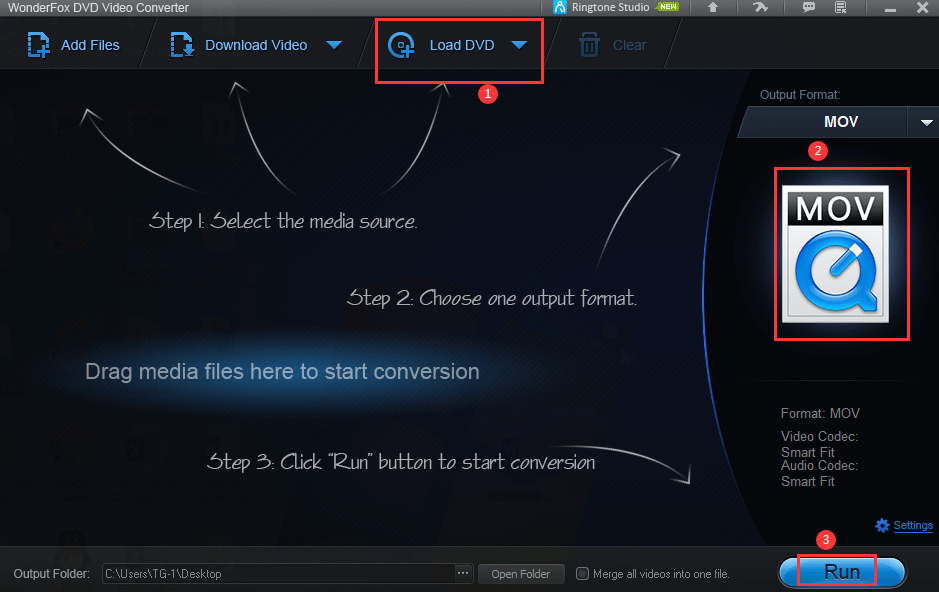
Insert your optical drive and click “Load DVD” to add your DVD to the program.
Step 2: Choose the output format.
There are more than 300 output formats for you to choose from, such as MPG, MP4, AVI, MKV, WMV, VOB, MKV, M4V, MTS, 3GP, ASF, VP9. You can easily find them when you click on the right window on the interface.
Step 3: Start the DVD conversion process.
Choose where you want to save the output file and click “Run” button to start the conversion process.
More features ofWonderFox DVD Video Converter
Quickly download your favorite videos from more than 300 video sites like YouTube, Liveleak, Hulu, Facebook, Twitter, Vimeo, etc.
Convert your video files to 300+ formats.
Convert SD videos to HD videos.
Convert videos and DVDs to digital devices, including TVs, smartphones, desktops, laptops, tablets, handsets, etc.
Backup old and scratched DVDs to copies.
Insert subtitles to DVDs and videos.
Extract required audio files from videos and DVDs.
Edit DVDs and videos as you want. (Cut, clip, crop, add effects, merge, trim, rotate, watermark, etc.)
Automatically find the main movie from 99 titles.
1:1 quick copy DVD Disc to DVD Folder and ISO Image.
Pros
Easy to use.
Support the multilingual interface, English, Japanese, German, etc.
Support batch conversion mode, you can add up to 10 videos at a time.
Multiple gadgets into one.
Various output devices and formats for conversion.
Fast ripping speed without any quality loss.
Cons
Works only with Windows.
Final words
WonderFox DVD Video Converter is a full-featured software that supports almost all popular formats and devices. In addition, it also supports various types of DVDs, 99-title DVDs, fitness videos, music videos, TV series, movies, etc. If you have the need to download videos and convert videos, it can also satisfy you in the same tool, so it is a good and cheap program and you can enjoy many features. Please try to use it, we believe you will be satisfied with it. However, kindly note that please use the ripping feature reasonably within the scope allowed by the law, any illegal commercial purpose is not advocated by us.
The world of IT is always looking for newer, more interesting ways to automate the most tedious tasks in our routine; like waiting for hours for your favorite movie to load on your laptop, to simply getting up and checking whether there are eggs in your fridge. 5g networks are promising you up to 1.3Gbps, and with IoT, your fridge will be able to tell your phone that you are out of eggs! Experts who have undergone blockchain training are looking to combine 5G networks and blockchain to make even more out of the advantages that the separate technologies have to offer.
Why all the fuss about 5G
You may have come across the term Industry 4.0 or the fourth industrial revolution. Many tech experts are now heralding the advent of 5G network as one of the main hallmarks of the fourth industrial revolution. Although 5G has not been fully rolled out and 4G is running parallel with it, everyone is excited about 5G.
5G refers to fifth generation wireless networks, which is an advancement of the 4G LTE network. Below are some of the reasons why everyone is looking forward to having it on their smartphones or business:
1. Better bandwidth
More people now own smart devices; this essentially means that the number of devices that will be trying to connect to the internet will increase significantly. 5G signals take shorter times to travel, which means lower latency, as little as one millisecond. 5G will enable telecommunication companies to offer better services to all their consumers. With 5G, pages will load faster and give users a better experience.
2. Speed
With 5G, there will be reduced barriers to optimum speed, which will make it almost 20 times faster than 4G. It is estimated that 5G broadband networks will offer consumers at home up to 20Gb/s, which is beyond incredible. This will allow you to send and receive essential data much faster than ever before.
3. Increased innovation in technological products
Companies like Google who are looking to create driverless cars will be able to do so with the advent of the 5G network. Consumers will also have access to better advancements in retail, medical care, and personalization. The combined advantage of incredible speeds, improved bandwidth, and low latency will allow tech companies to release better robotics, cloud computing, AR, Virtual Reality, and immersive education solutions.
4. Internet of Things (IoT)
Internet of things is a system where computing devices, digital and mechanical machinery, and objects are interconnected, fitted with a unique identifier, and can transmit data or communicate without any human-human or human-computer interaction.
This technology is expected to transform the manufacturing industry, with the ability of different machines communicating or controlling one another being the main advantage. However, IoT is also being applied in day to day tasks. Tech giant Cisco estimates that global data traffic will increase elevenfold, with most of the data coming from devices communicating with each other. Machine-to-machine (M2M) communication will only be possible with the kind of speeds that 5G network offers.
5. m-Health
Many consumers are now in need of technology that keeps up with changes in their health in real time; blood pressure, pulse rate, and other key indicators of wellbeing. Many digital devices are now being outfitted with a reliable health monitoring device, and 5G will facilitate further development and research into these solutions.
Possible issues in the telecommunication industry
There is a new technological advancement almost every waking minute, which means that telecommunication industries must keep transforming itself to remain relevant. Advancements have come their way, since 2000 when the internet first hit the IT world. 2019 is the year of cloud technology, IoT, microservices, augmented and virtual reality, among other trends. While these advancements are offering them the opportunity to grow, here are some of the challenges that they have experienced:
The need to upgrade their infrastructure
Telecommunication industries are faced with the challenge of improving their obsolete infrastructure with newer facilities that will keep up with emerging technologies. They also need to offer their customer better, reliable and secure voice and data services.
The IoT issue
It is predicted that there will be over 21 billion interconnected devices by 2020 as IoT becomes more ingrained in day to day life. To support the massive demand for IoT, telecom companies will need to install robust infrastructure and platforms.
Changing consumers’ tastes
Having millions of subscribers essentially means different opinions, preferences, and tastes. Telecom companies must, therefore, get back to the drawing board and device new or customized solutions to cater to their clients’ needs. They must come up with services that cater to their clients’ needs and also offer a reliable stream of revenue. This again also adds complexity to the billing, customer service, and order fulfillment logistics.
The solutions that combining 5G and blockchain offers
Blockchain is most famous for efficient data distribution and security it offers its users. The ability to share information on a network of computers without the fear of it being altered provides a great addition to the myriad of advantages that 5G already has.
IoT security
Tech experts are looking at the benefits that integrating 5G and blockchain will have for the internet of things. 5G will provide the speed and bandwidth to run blockchain operations smoothly. 5G also increases node participation, shortens block times and drives forward on-chain scalability. All these functions will serve to improve IoT.
Blockchain may provide the security needed to run the program. Right now, identification of devices in IoT is done using cloud-based servers that have databases for identification and other purposes. These databases are hardly secure, with their vulnerabilities being exposed and causing concern to many clients wanting to store data on cloud servers.
Blockchain can be the secure go-between for devices connected via 5G coverage. Again, since blockchain is decentralized and uses encryption technology, it can secure the identity of all participating devices. Every device can use its own blockchain address for identifying it and concealing its identity from other users.
Conclusion
The implication of combining two emergent technologies with high potential can only bring good tidings to the telecom industry.
With the way the workflow aspect of the business world is changing, there is much to think about. Most areas that come to mind have changed in some way, like the use of audio transcription. Audio transcription is well known, and it’s something that a lot of professionals use in numerous industries. By any means, finding the right online transcription provider is a vital matter to tend to. Most providers can provide you with many things but is the one you’re looking into the right option? You have to think about the elements of the provider (security, speed, cost, etc.), and all of them are important.
As you try to find the right provider, you always want to keep your priorities and key needs in mind. By finding the right provider, you’d be ensuring that extra audio reinforcement. Now when it comes to music, you want to be able to make sure music is being transcribed right the first time around.
Are You Guaranteed The Proper Accuracy?
There isn’t anything more vital than accuracy when you’re looking to transcribe audio file In a sense, having a transcription that’s as accurate as possible is ideal. Which is why having a service provider with labor behind it is ideal. Typically, services that use people instead of software tend to work a little better. The choice is yours, but having accurate transcription work for your audio files is key. It’s going to take some time to find a service you can trust, but having that quality can come a long way.
Finding the right programs to get the job done takes some time, but there are certain programs that stand out amongst the crowd. There are even programs available that will automatically transcribe your music for you like the following:
Akoff Music Composer – This is a program that’s mainly known for its automatic abilities when transcribing music. It uses a sophisticated process in order to create a MIDI sequence that’s turned into the format of an audio file. Plus, it can also analyze the structure of the file too.
ScoreCloud – Whether you’re advanced or a beginner, this program can be great for you. Essentially, you could say that this is a translator, but instead of translating a language, it transcribes music. Users of this program can easily transcribe songs into sheet music without a hassle in sight. It works best for music lovers as well as composers, and it offers scores from MIDI or audio files.
Transcribe! – Another program that helps people to transcribe their recorded audio files. You can work out music easily whether you’re recording or transcribing. It’s the ideal transcribing audio player with enhanced capabilities that can make your transcribing services much easier. Some users can use the program for practice if they want to. It’s more like a program made for beginners who need to get into the groove of things.
Having the right program or even an app in your corner makes the matter easier and more convenient. Just like other areas of the world, the music scene is evolving as well.
We’re well into the digital era, and time when so much mission-critical business requires reliable and high-performance WAN connectivity. As bandwidth intensive applications like 4K video-streaming and UCaaS continue to grow in popularity, WAN performance will need to be able to keep up. As a result, WAN optimization is a priority for enterprises.
With the increase of SD-WAN adoption, there are a myriad of approaches to WAN optimization. However, few are able to provide a holistic solution that takes into account all the aspects of a modern WAN. On the surface, this is understandable. Properly addressing the challenges of the last mile, middle mile, mobile users, and cloud services is a tall order. Getting packets from point A to point B faster sounds simple, but there’s a lot that must occur “under the hood” to make it happen.
This is where the benefits of cloud-native SD-WAN, a.k.a. SDWaaS (SD-WAN as a Service), really shine. SDWaaS offers a few fundamental benefits that extend to WAN optimization and enable enterprises to get the most out of their WAN while using a converged platform. Here, we’ll dive into some of the specific and explain how SDWaaS takes a modern approach to WAN optimization. To get to know more about the best SD-WAN services out there, keep reading. There is still a lot of information you wouldn’t like to miss.
How cloud native SD-WAN enables WAN Optimization
Understanding how SDWaaS is so effective in delivering WAN optimization benefits for the modern enterprise starts with understanding what makes SDWaaS different from other forms of SD-WAN. SDWaaS offers a converged cloud-based WAN infrastructure that delivers not only networking but security. The underlying private global backbone is supported by Points of Presence (PoPs) around the globe and is backed by an SLA. Security features like NGFW, secure web gateway, anti-malware, and IPS are baked-in to the network.
This all comes together to create a converged global network from one provider, meaning that complex integrations aren’t required to enable optimization. Where on-prem appliance-based SD-WAN would require additional appliances, if it could even address a given challenge at all, SDWaaS delivers WAN optimization as an inherent part of the network. In short, appliance-based SD-WAN is effectively just an overlay while SDWaaS also delivers a cloud-based infrastructure.
With that understanding out of the way, let’s dive into some of the specific benefits of SDWaaS for WAN optimization.
WAN optimization for the last mile
The last mile has been one of the more difficult challenges facing WAN engineers for years. Solving for all the problems that can pop up between an ISP and an endpoint can be next to impossible. Cloud native SD-WAN helps solve these problems in a number of ways, including:
Intelligent Forward Error Correction (FEC)– Packet loss is one of the biggest issues in the last mile. Lost packets mean degraded performance. Correction packets enable automatic regeneration of lost packets. Additionally, an intelligent algorithm makes it possible to scale FEC down or up depending on the rate of packet loss and network capacity.
Packet Duplication– In some cases, packet loss is simply too high for FEC alone to solve the problem. This is where packet duplication comes in. Sending duplicate packets to both links on an active-active connection enables enterprises to address even high packet-loss issues in the last mile.
Active-active links– SDWaaS enables multiple Internet links to be used in an active-active HA (high-availability) configuration. Intelligent monitoring software then ensures the link with the least packet-loss is used to route data.
Dynamic PoP selection– This feature allows the network to automatically send traffic to the PoP with the lowest latency and dropped packets.
TCP Proxy– SDWaaS TCP proxies allow for larger TCP windows, which can inherently improve throughput. Further, advanced congestion control lets enterprises maximize the efficiency of their utilization.
QoS– Traffic shaping features like application priority, Policy-based Routing (PbR), and bandwidth throttling allow mission-critical apps to take priority and ensure enterprises get the most important packets to their destination first.
WAN optimization for the middle mile
While the last mile has been a bane for WAN engineers, middle mile optimizations can go a long way as well. The SLA-backed global private backbone is one of the most obvious benefits of SDWaaS here. The public Internet offers no SLA, but SDWaaS does.
Further, the full-mesh topology of the PoPs allow for optimized routing of data. While the geographically closest PoP is usually the best option, that isn’t always the case. SDWaaS can account for both situations. Similarly, dynamic path selection is used to measure latency and packet loss across the ISPs that connect the PoPs. The best path is selected based on the data, further improving WAN performance.
WAN optimization for cloud and mobile
Cloud and mobile are areas where many appliance-based SD-WAN solutions struggle. It is difficult to take an on-prem solution and optimize for cloud and mobile. SDWaaS architecture makes this simpler and enables WAN optimization for the cloud and mobile users.
For example, in many cases SDWaaS PoPs are in the same datacenters as popular cloud service providers like AWS, Azure, and Google. Since the PoPs reside in the same IXP (Internet Exchange Point), SDWaaS can deliver performance comparable to services like AWS Direct Connect without the additional cost.
The PoPs also play a key role in optimizing performance for mobile users. Regardless of their location, mobile users are connected to the SDWaaS PoP nearest to them. From there, the same optimizations and security features made possible for office users are available to mobile users. The baked-in SDWaaS security then enables organizations to set granular access controls to limit the resources accessible by a given mobile users.
All these advantages come together to result in one thing: improved throughput across the board. While there are multiple aspects to the modern enterprise WAN, the end goal is still to deliver the best performance possible from your WAN investment. The cloud-native approach plus global private backbone found with SDWaaS makes that possible for today’s WANs. The converged nature of SDWaaS means enterprises can bring their WAN optimization efforts “under one roof” and improve their WAN throughput.